
Bluegrass is a style of American folk music known for its high, lonesome sound. The genre developed in the Appalachians in the 1940s, largely led by mandolin player Bill Monroe – known as the Father of Bluegrass. Historically, bluegrass music incorporates melodies of traditional folk songs from Scotland, Ireland, and England, played in an American Appalachian fiddle style.
Often considered a form of country music, bluegrass songs are generally characterized by high vocal harmonies and specific instrumentation. Bluegrass is almost exclusively performed on guitar, fiddle, banjo, mandolin, and standup bass, with the occasional appearance of harmonica, accordion, dobro, and other various string instruments.
Basics
Bill Monroe is widely credited as the “Father of Bluegrass,” combining elements from traditional Appalachian string bands and African-American musical traditions. Monroe’s innovative use of the mandolin, coupled with high-energy performances and tight vocal harmonies, set the foundation for the genre.
Monroe’s 1945 collaboration with banjo player Earl Scruggs, who popularized the three-finger picking style, marked a key turning point in bluegrass history. This unique combination of instruments—mandolin, banjo, guitar, fiddle, and upright bass—solidified the bluegrass sound, creating a hard-driving, high-tempo musical experience.
Over time, bluegrass incorporated influences from other genres like jazz, blues, and even pop music, leading to variations such as “newgrass.” In the 1950s, rock and roll overshadowed bluegrass, but the genre experienced a revival in the 1960s, partly thanks to festivals and recordings that introduced it to new audiences.
Bluegrass festivals help keep the tradition alive, with performers continuing to innovate while honoring its roots. The genre’s adaptability and its foundation in both European and African musical traditions helped it maintain a lasting presence in American culture.
Old-time music as a precurser to bluegrass
American old-time music has deep roots in rural traditions that blend European and African influences. This style of music, largely developed in the Appalachian region, emerged from the folk traditions of British, Scottish, and Irish immigrants, as well as West African rhythms brought by enslaved peoples.
Over time, different regions of the U.S. developed their own styles, creating a rich tapestry of sound and tradition. Traditional folk tunes were passed down through generations American families, preserving their distinct musical styles. Geographic isolation of the Appalachian area allowed these traditions to remain largely unchanged in local culture.
By the late 1800s, as railroads and recorded music spread, Appalachian music began incorporating vaudeville, African-American blues, and minstrel tunes. This blending of styles led to the creation of new genres, including “Old Timey” music, which many consider a precursor to bluegrass and early country music.
Old-time music was Initially played for local entertainment and dances, and became a central part of community life in rural America long before the advent of radio and recorded music. Its instrumentation, which includes the fiddle, banjo, and other stringed instruments, was heavily influenced by the diverse cultural backgrounds of the early settlers.
The introduction of recording technology in the early 20th century helped popularize the style, with record companies marketing the music as “hillbilly” or “old-time tunes.” These recordings, made for and by rural Southern audiences, documented traditional fiddle tunes, ballads, and camp meeting hymns, preserving them for future generations.
Old-time music is focused on group participation, with all musicians playing together in unison rather than taking turns with solos. This participatory nature makes old-time music more social, as it is often played in informal settings such as jams and square dances.
The tradition of old-time music continues to thrive today. Festivals, such as the Appalachian String Band Festival in West Virginia, draw thousands of musicians and fans each year. These events offer opportunities for musicians to compete, perform, and most importantly, to jam with others in informal settings.
The fiddle in the USA
Scottish and Irish immigrants played a key role in bringing fiddles and traditional fiddle tunes to the United States during the colonization of the Eastern region, particularly in the Appalachian areas. These immigrants, often settling in rural enclaves of places like western Virginia, carried their violins (or “fiddles”), which became central to the music of the region.
Their lively tunes, often passed down orally, evolved into what is now recognized as American folk and bluegrass music, blending their Celtic melodies with new influences in their adopted homeland.
The banjo in the USA
At the same time, African Americans brought the banjo to the U.S., a significant cultural contribution from West Africa. Enslaved Africans introduced the banjo to the southern plantations, where it became a key instrument in early African American music.
Originally, these banjos were made with gourd bodies and animal skins. Over time, the banjo became widely adopted in American music, contributing to the development of genres such as old-time music and bluegrass, intertwining with fiddle tunes and creating a unique blend of musical traditions.
The mandolin in the USA
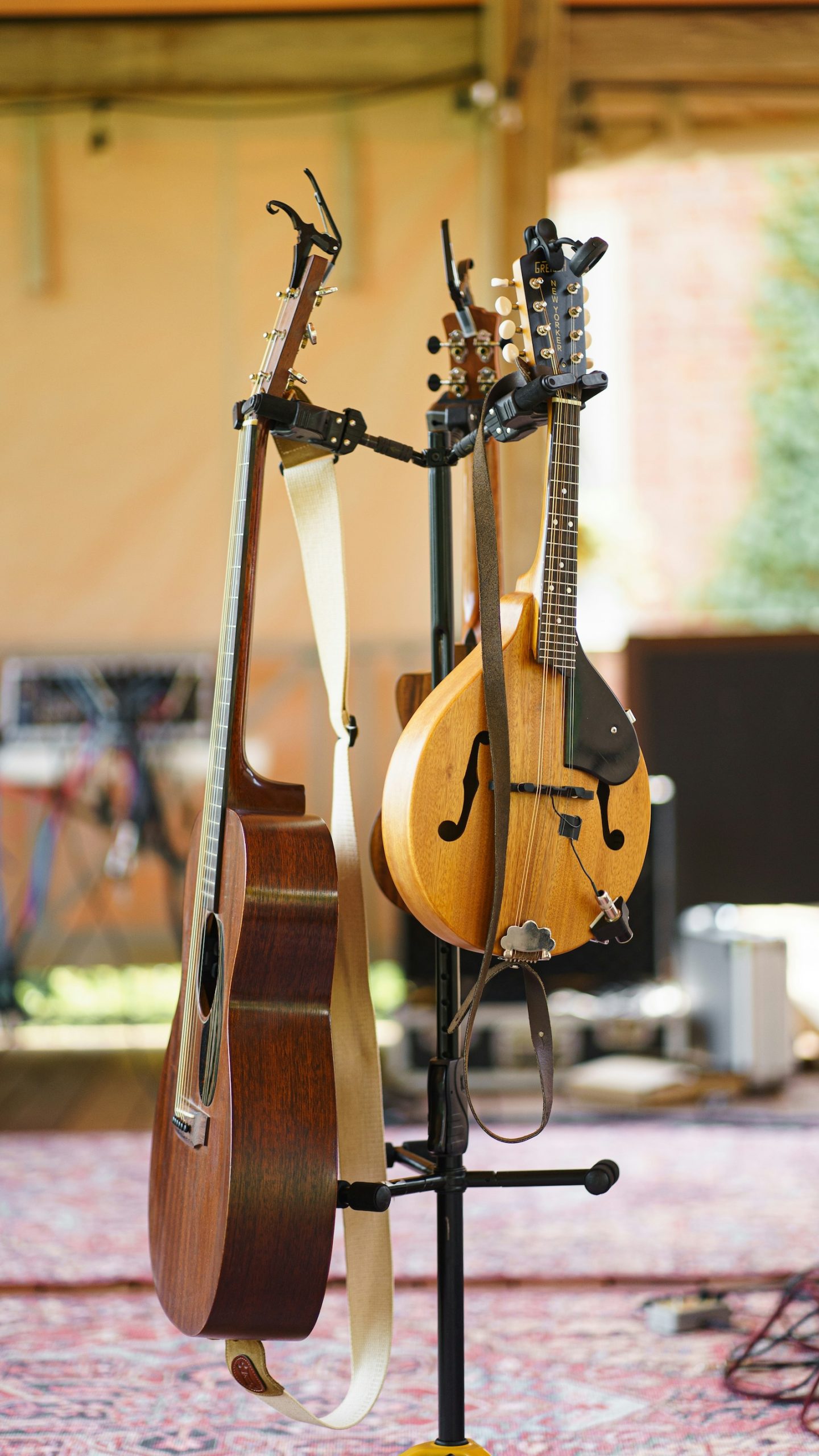
The mandolin became a key instrument in American music as it circulated throughout the Appalachian region. In the early 20th century, mandolins were often a cheaper, second-hand alternative to guitars, which were beginning to gain popularity.
As guitars gained prominence in the 1930s, mandolins became integral to traditional string bands, blending with fiddles and banjos to create the distinct sound of bluegrass. The mandolin’s bright tone and ability to play fast-paced melodies made it an ideal addition to these evolving musical genres.

The guitar in the USA
The introduction of the steel-string guitar can be attributed to German luthiers, such as C.F. Martin, who brought their craftsmanship to Pennsylvania in the early 1800s. Martin’s innovations, particularly in the design of the steel-string guitar, provided greater volume and a brighter tone, which appealed to musicians in folk and bluegrass music.
By the 1930s, the steel-string guitar had become a staple of American music, especially in rural and Appalachian regions, contributing to the development of country, folk, and eventually, bluegrass music.
The double bass in the USA
The upright acoustic bass, or double bass, made its way to the United States in the 19th century, brought by European immigrants. Originally used in classical orchestras, the instrument began to gain popularity in jazz, folk, and country music in the early 20th century.
In the 1940s, the upright bass became a foundational instrument in bluegrass, country, and early rock and roll, thanks to its deep, resonant tone. Players like Bill Monroe’s bassist, Cedric Rainwater, helped establish its central role in the evolution of American roots music.
The Role of Technology in Popularizing Bluegrass Music
Bluegrass owes much to the technological advancements that have shaped its evolution. From phonographs to radios and beyond, these innovations have played an integral role in bringing bluegrass from rural communities into homes across America.
Invention of the Phonograph: A Game Changer for Bluegrass
The invention of the phonograph by Thomas Edison was more than just another scientific breakthrough; it revolutionized how people experienced music. For genres like bluegrass which originated within close-knit regional communities, this invention offered a platform for their unique sounds to reach far-flung audiences.
This newfound ability didn’t merely broaden listenership but also democratized access to diverse musical forms previously confined due to geographical boundaries or socio-economic constraints. It’s no exaggeration then when we say that without Edison’s innovation, the course of our beloved bluegrass would’ve been drastically different.
Radios Bring Bluegrass Nationwide
No sooner had the Phonograph taken root than along came another marvel – Radio Broadcasting. This technology offered free entertainment right out of the box once purchased, making it particularly appealing during tough times like The Great Depression. These Radios brought different types of music to American households, including our cherished bluegrass which till then remained largely unknown or inaccessible due to its regional nature.
Radiosets, with their capability to broadcast shows nationwide, played a pivotal role in propelling bluegrass to national prominence. Country-themed radio programs, such as WSM’s Grand Ole Opry, became immensely popular platforms regularly featuring prominent figures within country and bluegrass circles, thus helping spread awareness about this genre amongst a wider audience base.
Beyond home music players, it was perhaps radio that had an even greater impact on promoting bluegrass across America. With its advent during the 1920s came new opportunities for musicians like Bill Monroe who could now reach audiences far beyond their local communities through live performances aired by stations such as WSM studios.
Radios became household items allowing people access to diverse types of music without needing physical copies or attending concerts personally. This widespread accessibility via radio meant listeners could enjoy high-quality performances within their comfort zones.
Beyond Radio broadcasting, the next leap came from television. During the 1950s, many variety shows aired featuring established acts performing hit songs. This combination led to a golden era for country and blues, witnessing exponential growth both in terms of listenership as well as the number of musicians adopting this style.
Bill Monroe – The Father Of Blue Grass Music
We cannot overlook the contributions made by Bill Monroe, considered the father of this genre. He formed his band, “The Monroe Brothers,” during the 1930s, establishing himself as one among the pioneers shaping the future course for this genre. His style included the use of acoustic instruments along with distinctively high vocal harmonies, which have become defining characteristics commonly found among future Bluegrass bands.
Acoustic instruments and high vocal harmonies
Incorporating songs using acoustic instruments wasn’t just an aesthetic choice but rather a strategic decision taken by Monroe, who wanted to create a unique sound setting his band apart from others. Most importantly, his choice of incorporating high vocal harmonies set a standard followed by many subsequent Bluegrass bands. These distinctive elements can still be heard in the works of contemporary artists today, reflecting the lasting legacy left behind by Monroe and his band.
The Evolution and Influence of Bluegrass Bands
The post-war era saw the formation of numerous bluegrass bands that took inspiration from various genres to create their unique interpretations.
This influence not only permeated within traditional circles but also seeped into today’s modern country scene, with many contemporary artists incorporating elements from this vibrant genre into their work.
Blue Grass Boys’ Impact on Bluegrass Band Formats Today
In the world of bluegrass, Bill Monroe’s band “The Blue Grass Boys” set an industry standard for future ensemble formats by showcasing innovative use of acoustic instruments play coupled with high vocal harmonies. These characteristics have since become defining features for many present-day bluegrass ensembles, making it a quintessential element associated with this genre.
A typical format would include guitar (played by Monroe), mandolin, fiddle, banjo, and bass – each contributing towards creating layered musical texture synonymous with the soundscapes created during live performances. Additionally, the distinctively high vocal harmonies added depth to their compositions, thereby setting them apart among other popular genres at that time.
Earl Scruggs’ Three-Finger Style Revolution
The landscape changed dramatically when Earl Scruggs joined Bill Monroe’s band as a banjo player in 1945, introducing what is now referred to as ‘Scruggs’ three-finger style’. This technique involved picking strings using three fingers instead of the traditionally used clawhammer method, which relied primarily on the thumb or index finger. This revolutionized how musicians approached playing this instrument, allowing greater speed while maintaining clarity, resulting in intricate melodies being played on the banjo, which was previously unheard of.
Musicians who heard about Scrugg’s revolutionary approach began incorporating his techniques into their own performance repertoire, thus transforming how banjos are played even to this day. It wouldn’t be wrong to say that Earl Scrugg’s contribution has been instrumental in shaping the interpretation and performance styles associated with widely performed progressive Bluegrass Music.
Bluegrass music, deeply rooted in various traditional genres, gained traction post-WWII with many bands creating unique interpretations. Bill Monroe’s band set the industry standard for ensemble formats while Earl Scruggs revolutionized banjo playing. These influences are still evident in today’s bluegrass and modern country scene.
Leave a Reply